Building a Digital Roadmap for Compassionate, Neighbourhood-Based Care with Saint Francis Hospice
How we worked with Saint Francis Hospice to turn digital ambition into an implementable plan aligned to long-term strategy and sustainable growth.
Saint Francis Hospice (SFH) wanted to understand how innovation, including digital, could meaningfully support its evolving strategy and strengthen its core mission: delivering exceptional, compassionate care for people living with life-limiting illness and their loved ones.
The hospice is on an ambitious journey to extend its reach across Barking & Dagenham, Brentwood, Havering, Redbridge and West Essex. Central to this ambition is a shift toward a Neighbourhood Model of Care, bringing hospice expertise earlier, closer to home, and more effectively into community and system partnerships.
To support this shift, SFH recognised that its existing ways of working were under strain. Like many hospices, demand for community-based care was rising, staff and volunteers were stretched, and systems had grown fragmented over time. Key processes were heavily manual, data was inconsistent, and information often sat in silos.
Staff described the daily friction clearly:
“We write the same thing three times in three different places.”
“We should be spending our time with people, not logging in and waiting for pages to load.”
While the hospice has strong values, committed teams, and deep clinical expertise, it lacked the foundations needed to scale these strengths across neighbourhoods. Leaders wanted a clear, realistic roadmap that aligned digital innovation with strategy, culture, and financial sustainability, without compromising the human relationships at the heart of hospice care.
Our Approach
Working in partnership with Saint Francis Hospice, we designed and delivered a Digital Opportunities Assessment and a four-year transformation roadmap. The work combined research, co-design, and practical experimentation, ensuring recommendations were grounded in lived experience rather than theory.
1. Discovery and Insight
Over a ten-week diagnostic phase, we engaged widely across the hospice:
- 7 leadership interviews and 107 staff survey responses
- 5 co-design workshops with staff, volunteers, donors, and families
- 2 technology and data mapping sessions
This created a shared understanding of the hospice’s current state, spanning clinical workflows, volunteer coordination, referrals, data use, and digital confidence.
The findings went beyond technology. While many people were open to change, digital was often seen as something that “gets in the way” of care rather than enabling it. Staff highlighted the need for clearer leadership direction when it comes to digital, role-specific training, and reassurance that innovation would support compassion, not replace or hinder it.
Crucially, the work surfaced a strong appetite for change, if it was practical, inclusive, and clearly linked to better care.
2. Testing Concepts
To move from insight to action, we co-designed and tested two early concepts, allowing SFH to explore what change could look like in practice.
a) Digital Volunteer Platform
With over 600 volunteers, SFH relies on an extraordinary community of people whose time and skills are critical to its mission. Volunteers told us that existing systems were fragmented and hard to navigate:
“You don’t always know what’s happening or whether information is up to date.”
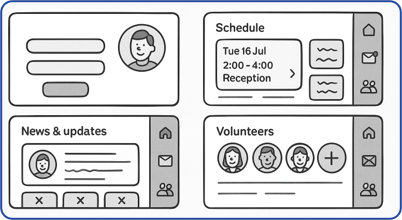
The pilot explored a single digital platform for communication, scheduling, training, and recognition. It demonstrated how simple digital tools could reduce administrative burden, improve inclusion, and offer more flexible ways for people to contribute, including remote and hybrid volunteering.
b) Virtual Ward Concept
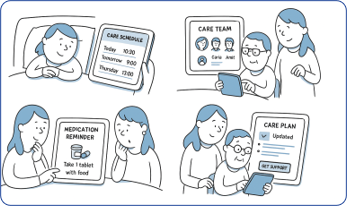
The second prototype explored how SFH could better support people at home using light-touch digital tools, such as shared care plans and symptom tracking.
Carers and loved ones of those receiving care, valued the idea of being more informed and involved, while also emphasising the need for simplicity and accessibility. The pilot reinforced that digital support must be optional, human-centred, and adaptable to different levels of confidence and access.
Insights from this work are now shaping how SFH integrates virtual support into its neighbourhood and community services, extending reach without diluting personal care.
3. Building the Roadmap
The final output was a four-year Digital Roadmap focused on achievable, high-impact change. Rather than leading with technology, the roadmap balanced infrastructure, culture, workforce capability, and service redesign.
Key priorities included:
- Fixing the foundations: improving infrastructure, connectivity, and system integration
- Reducing friction: digitising referrals and key clinical workflows to remove duplication and paper-based processes
- Building trust in data: improving quality, visibility, and sharing across teams and partners
- Empowering people: role-specific digital training and leadership development
- Enabling neighbourhood care: aligning tools and processes to support community-based, coordinated models of care
The roadmap also identified funding routes, including grant opportunities, partner collaboration, and low-cost quick wins, helping SFH plan change sustainably rather than relying on one-off investment.
Key Outcomes
The work created clarity, confidence, and momentum across the organisation.
- A shared understanding of digital purpose
Digital is now seen as a way to extend compassion, not a threat to it. - Validated concepts ready for development
Both the Volunteer Platform and Virtual Ward received strong internal support and clear next steps. - A credible, fundable roadmap
Leaders now have a practical plan that balances ambition with realism. - Improved confidence and engagement
80% of workshop participants reported feeling more confident talking about digital and service change.
For SFH, this marked a shift away from firefighting system issues toward building a joined-up, sustainable foundation for the future.
Supporting a Neighbourhood Model of Care
Crucially, the roadmap places innovation within SFH’s wider strategic move toward a Neighbourhood Model of Care.
In this model, digital enables rather than drives change:
- Shared systems support coordination across neighbourhood teams
- Virtual tools extend reach and continuity of care
- Digital referrals help people access support earlier
- Loved ones, volunteers, and professionals can collaborate more effectively
In neighbourhood-based care, shared information is essential. Teams can only work as one when they can see the same picture.
Why This Matters
This work was not about technology for its own sake. It was about time, trust, and sustainability.
By reducing unnecessary friction, Saint Francis Hospice is freeing up more time for care. By improving data and coordination, it is building confidence across teams and partners. By aligning innovation with its neighbourhood strategy, it is extending compassionate care beyond hospice walls.
Saint Francis Hospice now has the vision, confidence, and roadmap to deliver a hospice model that is digitally confident, operationally resilient, and deeply rooted in its communities.
Interested in learning more? Email us at theteam@carecity.org