Rethinking the Workforce: Growing New Roles from Within Social Care
In this interview, we explore how new roles are being embedded within social care; using apprenticeships to grow the workforce from within, strengthen services, and support NHS capacity across North East London.
At Care City, we’re rethinking how the future care workforce is built. With funding from Rayne Foundation, and in partnership with care providers and universities, we’re developing new Nursing Associate and AHP Assistant Practitioner roles that bridge the gap between social care and the NHS.
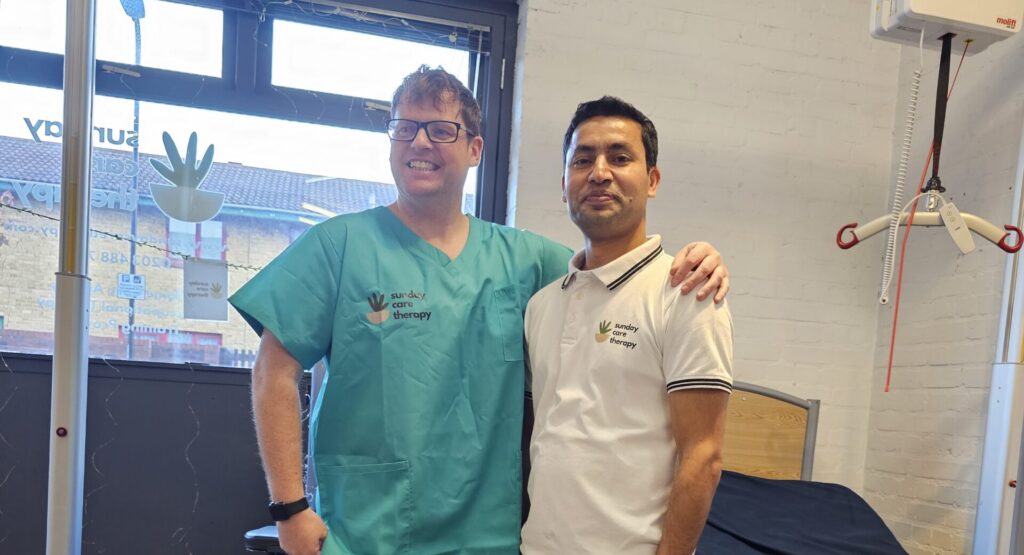
One example of this in action is Sohrab. His journey demonstrates what this model can achieve in practice, using apprenticeships to grow new roles from within the existing social care workforce. Now undertaking his Assistant Practitioner Apprenticeship, Sohrab is progressing towards qualifying as an Occupational Therapist (OT), enabling him to provide more specialist, hands-on support for residents while working more closely with NHS partners to increase capacity in the community.
At a time of rising demand and workforce shortages, this approach is helping to “grow our own” skilled professionals while strengthening care for communities. In this interview, Derek Sleater, Director, Sunday Care Therapy, reflects on what Sohrab’s journey made possible and why this model is now set to grow.
The moment it clicked
What was it about Sohrab’s journey that convinced you this model works?
Sohrab’s journey showed us that with the right support, apprenticeships can develop highly capable, reflective practitioners who are deeply connected to the communities they serve. What stood out was not just his clinical progression, but how quickly he translated learning into practice in a meaningful, person-centred way. Personally I trained as an apprentice so knew the value it brings to teams.
Was there a specific moment where you thought, “we need to do more of this”?
The turning point came when we saw Sohrab confidently applying OT principles in real-world situations while still learning—particularly in complex cases where communication, adaptability, and trust-building were key. It became clear that this wasn’t just a training route, but a workforce model that adds value early on. As a service we continually thrive to be multidisciplinary in our approach. Having an Occupational Therapist, Physio and Nurse in the team we knew we needed to expand into Speech and Language Therapy (SLT).
Before this experience, what were your assumptions about apprenticeships in OT and SLT?
Initially, there was some uncertainty about whether apprenticeships could deliver the same depth of clinical reasoning as traditional routes. Particularly going down a pathway that no one else has gone. There were also questions about capacity—whether services could realistically support learners while maintaining quality care. This experience challenged those assumptions.
Growing into the role
What changes have you seen in Sohrab, both professionally and personally?
Professionally, Sohrab has developed strong clinical reasoning, confidence in decision-making, and the ability to engage meaningfully with patients. Personally, we’ve seen a real growth in confidence, identity, and sense of purpose—he sees himself as part of the profession, not just training within it. As a service we always aim to go on some away training days with companies like Accora or Seating Matters. It’s amazing going on these courses and seeing the difference between Sohrab as a Deputy Manager and Sohrab as an OT student.
How has having an apprentice practitioner impacted your wider team?
It has created a stronger culture of learning and reflection. The team has become more intentional about supervision, knowledge-sharing, and explaining their clinical thinking. It’s also been energising—having someone learning brings fresh perspectives and curiosity. At Sunday Care Therapy we coined the term turning care into a career. Courses like this emphasise how this is achievable, giving other team members time to reflect on what they want their future in the service to be.
What surprised you most about supporting someone through this route?
How quickly value is added. There’s often an assumption that apprentices are a burden early on, but in reality, with the right structure, they contribute meaningfully while learning. The balance between service delivery and development was more achievable than expected.
Challenging the old assumptions
How does this pathway compare to more traditional routes into OT and SLT?
The apprenticeship route offers a more integrated learning experience—students are embedded in practice from the outset, which strengthens the link between theory and real-world application. Traditional routes can sometimes delay that level of immersion.
What strengths do apprentices bring that might be overlooked?
Apprentices often bring strong practical insight, resilience, and a deep understanding of the communities they come from. Many are already experienced in care roles, which gives them a level of empathy and adaptability that can be harder to teach.
Impact where it matters most
Have you seen any impact on patient care or service delivery as a result of this model?
Yes—apprentices contribute to continuity of care and help increase service capacity in a sustainable way. Because they are embedded in teams long-term, they build strong relationships with patients and communities, which enhances engagement and outcomes.
Do apprentices change the way services connect with communities? If so, how?
They can. Apprentices often reflect the communities they serve, which can improve trust and accessibility. Their lived experience and communication style can help bridge gaps that services sometimes struggle to address.
Building on what works
What gave you the confidence to commit to recruiting two more apprentices?
Seeing the tangible impact of Sohrab’s journey—on patients, the team, and service delivery—gave us confidence that this is not just viable, but valuable. It demonstrated that with the right infrastructure, this model can be scaled.
Why specifically one OT and one SLT? What gaps or opportunities are you responding to?
We’re responding to clear workforce gaps in both occupational therapy and speech and language therapy, particularly in community and preventative services. Bringing both roles in allows us to strengthen multidisciplinary working and better meet complex, overlapping needs.
Why partnership makes it possible
How important is partnership in making apprenticeships like this succeed?
Partnership is critical. Apprenticeships require alignment between education, service delivery, and workforce strategy. Organisations like The Rayne Foundation and Care City provide the infrastructure and vision, while universities ensure academic rigour. Without that collaboration, it would be very difficult to deliver this effectively.
For those thinking about starting
What would you say to another organisation thinking about taking on their first apprentice practitioner?
Start with a clear structure for supervision and support, and view it as an investment rather than a short-term pressure. The returns, both in workforce development and service impact, are significant. Also, work closely with partners and learn from others who have done it. It’s more achievable than it might initially seem.